Every year in late spring, the plum rain front quietly arrives, bringing days of relentless rainfall that gradually push river levels toward warning thresholds. As summer begins, intense downpours driven by southwesterly airflows can turn low-lying areas into lakes within hours. This is followed by the typhoon season extending into autumn, when strong winds and heavy rain often catch unprepared factories off guard. Taiwan’s “three-act flood cycle” plays out almost every year, yet many industrial facilities still rely on a reactive “deal with it after it happens” mindset.
The core issue is not how severe disasters are, but how slow the response is. Extreme weather is no longer occasional—it has become an annual certainty.
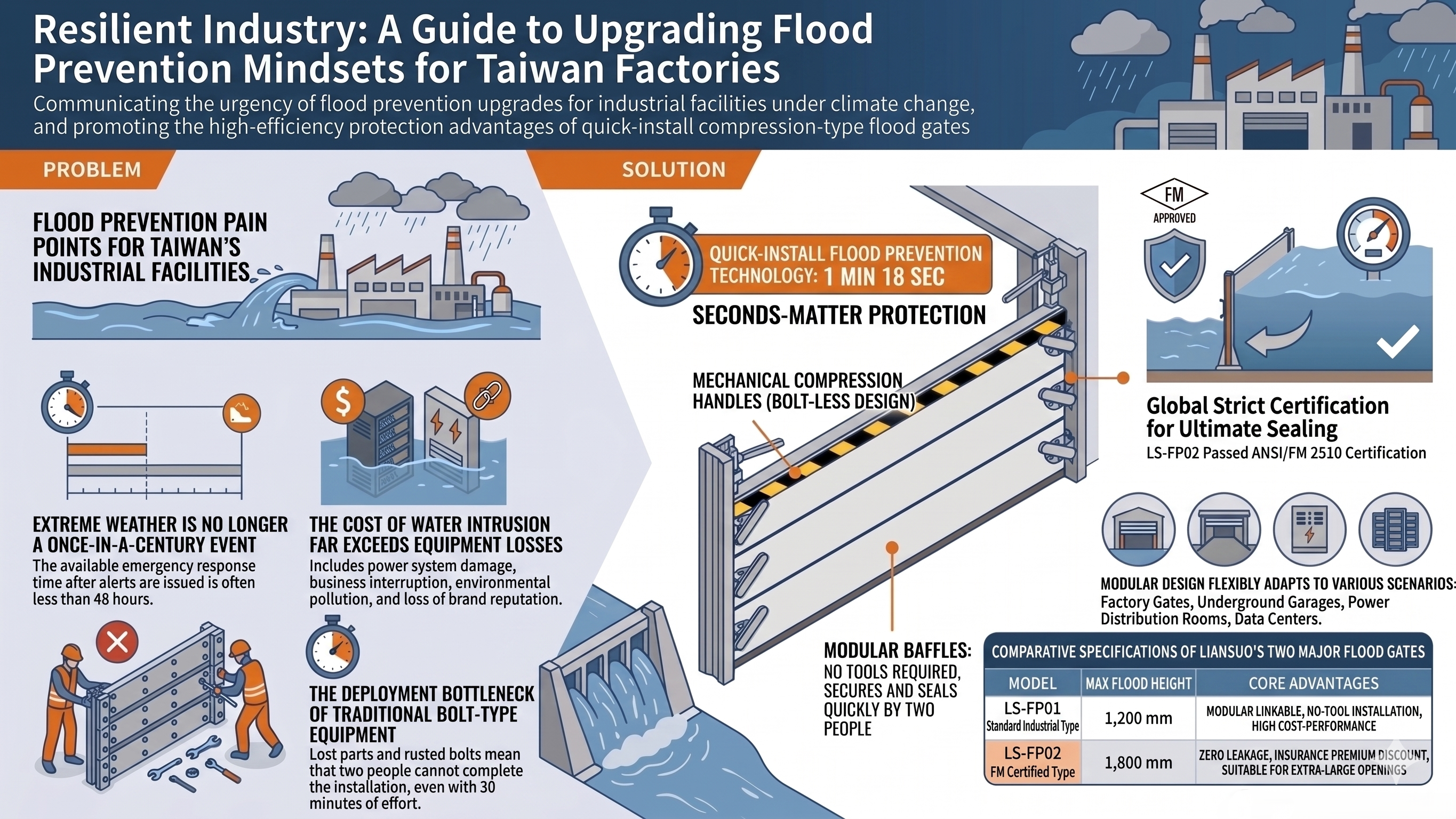
Climate change is redefining Taiwan’s rainfall patterns. What used to be considered “once-in-a-century” storms now occur every few years. Rainfall intensity during the plum rain season continues to increase, with daily precipitation records frequently broken. Although typhoon paths remain unpredictable, once a storm makes landfall, the window for response—from warning issuance to full impact—is often less than 48 hours.
For southwestern regions such as Yunlin, Chiayi, Tainan, Kaohsiung, and Pingtung—where terrain is low-lying and drainage systems are consistently under strain—a single heavy rainfall can halt factory operations for days. Meanwhile, underground parking facilities and urban industrial sites in Taipei, Taoyuan, and Taichung are increasingly affected by urban flooding. Flooding is no longer just a “southern Taiwan issue,” but a nationwide challenge for industrial facilities.
The True Cost of Flooding
The consequences of water ingress go far beyond visible water damage. Many operators still approach flooding with a “pump it out, dry it, and keep using it” mentality. In reality, once electrical rooms are flooded, repairs can take weeks. If a data center is affected, server damage and data loss are often irreversible. Flooding in chemical storage areas can trigger leaks, environmental contamination, or even fires, leading to regulatory penalties and legal liabilities that far exceed equipment losses. For energy storage systems, water exposure raises the risk of thermal runaway, posing serious challenges for both firefighting and insurance.
The real cost of flooding often lies in business interruption, customer loss, and reputational damage. In today’s highly integrated supply chains, the shutdown of a single critical facility can disrupt entire production lines and impact multiple partners.
From Preparedness to Rapid Response
Effective flood protection is not just about having equipment—it is about how quickly defenses can be deployed within a limited timeframe. After a typhoon warning is issued, on-site personnel must act fast. Traditional bolted flood barriers often become a bottleneck: rusted bolts that will not turn, missing components, or incomplete installation even after 30 minutes of effort. Before the barrier is ready, the storm has already arrived.
To address this real-world challenge, Liansuo Construction Technology has developed a rapid-deployment compression-type flood protection system. Its LS-FP01 standard industrial flood barrier features a mechanical compression design that requires no bolts or tools. Two operators can complete full installation in as little as 1 minute and 18 seconds, with a maximum protection height of 1,200 mm. It is suitable for factory entrances, logistics corridors, underground parking areas, and continuous flood barriers, with a modular design that adapts easily to various opening sizes.
For high-value critical environments such as semiconductor cleanrooms, data centers, and electrical rooms, the LS-FP02 FM-approved flood barrier meets the stringent ANSI/FM 2510 certification standard. It incorporates a three-directional, bolt-free compression system to ensure consistent sealing performance with near-zero leakage every time. With a maximum flood protection height of 1,800 mm and the ability to span openings up to 4,000 mm, it also supports insurance premium reductions and complies with FM Data Sheet 1-40, helping companies shift from reactive claims to proactive risk control.
Resilience as a New Standard
As extreme weather becomes the norm, disaster resilience is increasingly becoming a key criterion in client selection, insurance risk assessment, and supply chain partnerships. A well-designed and rapidly deployable flood protection system is not only a safeguard for assets, but also a signal to stakeholders that a facility is prepared for operational continuity and risk management.
The plum rain season has already begun, and typhoon season is close behind. Flood protection should not wait until warnings are issued to begin deployment.