With the growing number of industrial projects in Taiwan’s coastal regions, high-wind zones, and high-rise industrial facilities, the design of explosion venting walls can no longer focus solely on venting area requirements. Wind loads must also be considered as a critical part of the design process.
According to Liansuo Construction Technology Co., Ltd., a company specializing in industrial safety solutions, explosion venting walls are required to achieve two objectives simultaneously:
“Resist wind loads during normal operation and provide reliable explosion venting during an incident.”
Both requirements act upon the same wall system. Therefore, an explosion venting wall must not only relieve explosion pressure—it must also withstand severe wind events, including typhoon conditions. For coastal industrial facilities, wind resistance deserves particular attention.
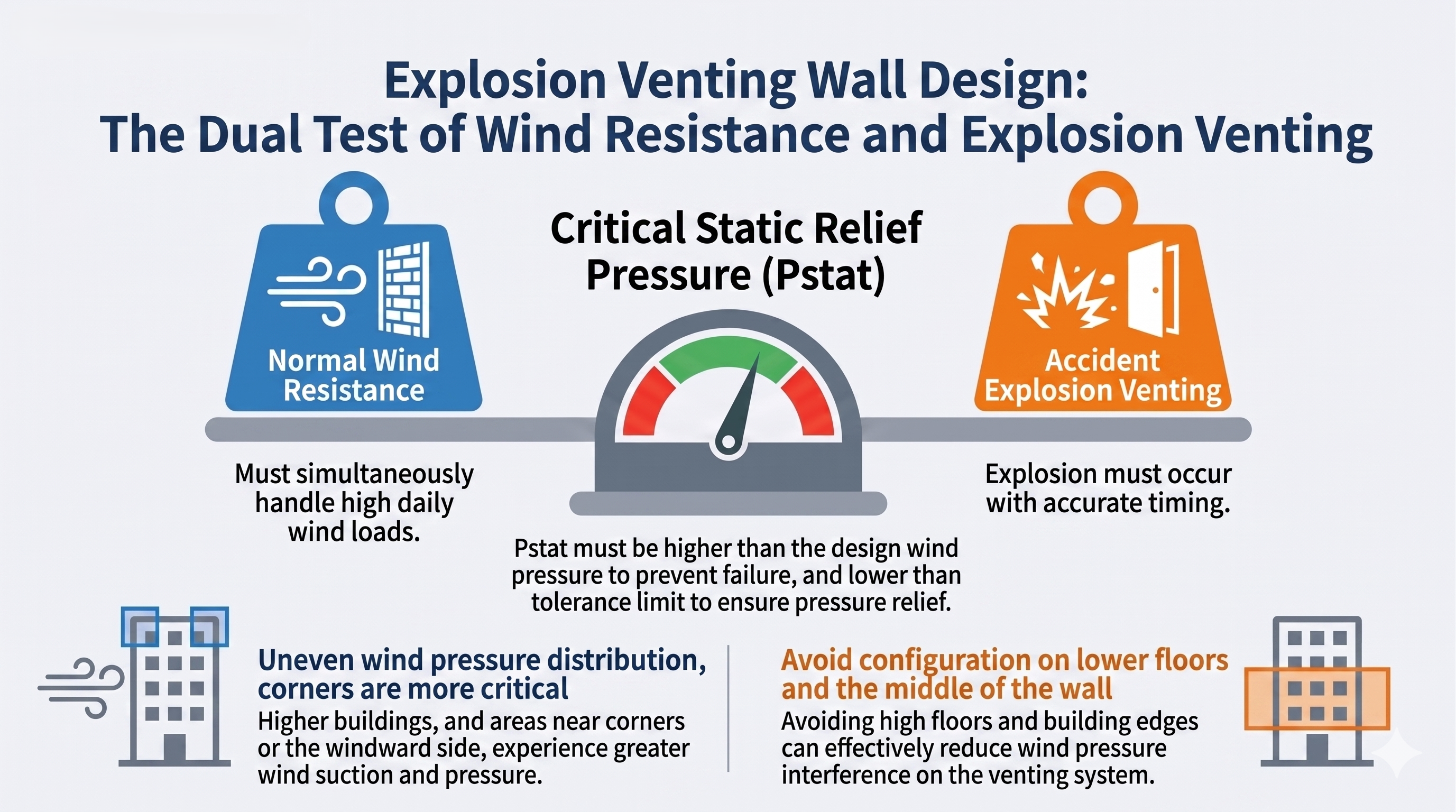
Wind Pressure Is Not Uniformly Distributed
According to the wind design principles outlined in FM Global Property Loss Prevention Data Sheet 1-28 (Wind Design) and ASCE 7 – Minimum Design Loads and Associated Criteria for Buildings and Other Structures, wind pressure on building surfaces is not evenly distributed.
In general:
- Wind pressure increases with building height.
- Suction pressures at building corners are typically higher than those at the center of wall surfaces.
- Windward walls, edge zones, and corner zones often experience the most severe loading conditions.
As a result, when an explosion venting wall is located on an upper floor, near a building corner, or on a windward façade, the available design margin can be significantly reduced.
The Engineering Window Between Explosion Venting and Wind Resistance
Explosion venting systems are typically designed with a specified static activation pressure (Pstat).
If the Pstat is too low, the venting system may open prematurely under strong wind pressures or external suction loads.
If the Pstat is too high, the system may fail to release explosion pressure quickly enough during an explosion event.
For this reason, the ideal explosion venting wall is not simply the one that opens most easily, nor the one that is strongest. Successful designs require a balance between:
- Wind resistance during normal operation
- Rapid pressure relief during an explosion
In coastal environments, high-wind regions, and high-rise buildings, this engineering window becomes increasingly narrow, making proper design even more critical.
Recommendations for Architects and Designers
Wind resistance and explosion venting requirements should be evaluated together during the conceptual design stage to avoid costly modifications later in the project.
Key considerations include:
- Locate process rooms requiring explosion venting at lower building levels whenever possible.
- Position explosion venting surfaces near the center of wall elevations rather than at corners or edge zones.
- Avoid locating venting surfaces on façades exposed to prevailing wind directions whenever practical.
- When unfavorable locations cannot be avoided, coordinate with the venting system supplier early in the design process to develop an appropriate structural solution.
- Verify Pstat, design wind pressure, fixing methods, and connection details as an integrated system rather than as separate design elements.
Product Selection Matters Too
When evaluating explosion venting wall systems, designers should consider more than just the required venting area.
Important questions include:
- Does the system use different design details for wall center zones and corner zones?
- Can the venting elements release internal explosion pressure rapidly while still resisting external wind suction forces?
- Has the Pstat value been validated through testing?
- Is the connection system designed to integrate reliably with the primary building structure?
Conclusion
Wind resistance and explosion venting are not competing design objectives—they are equally essential requirements.
A properly designed explosion venting wall should:
- Resist wind loads throughout normal service conditions
- Reliably release pressure during an explosion event
Considering both requirements together from the earliest stages of project planning is not only the most economical approach, but also the most reliable way to achieve a safe and effective explosion protection design.