Recently, many areas across Taiwan have been affected by heavy rainfall, resulting in road flooding, urban waterlogging, basement backflow, driveway flooding, and impacts on critical facility areas such as factory entrances and equipment rooms.
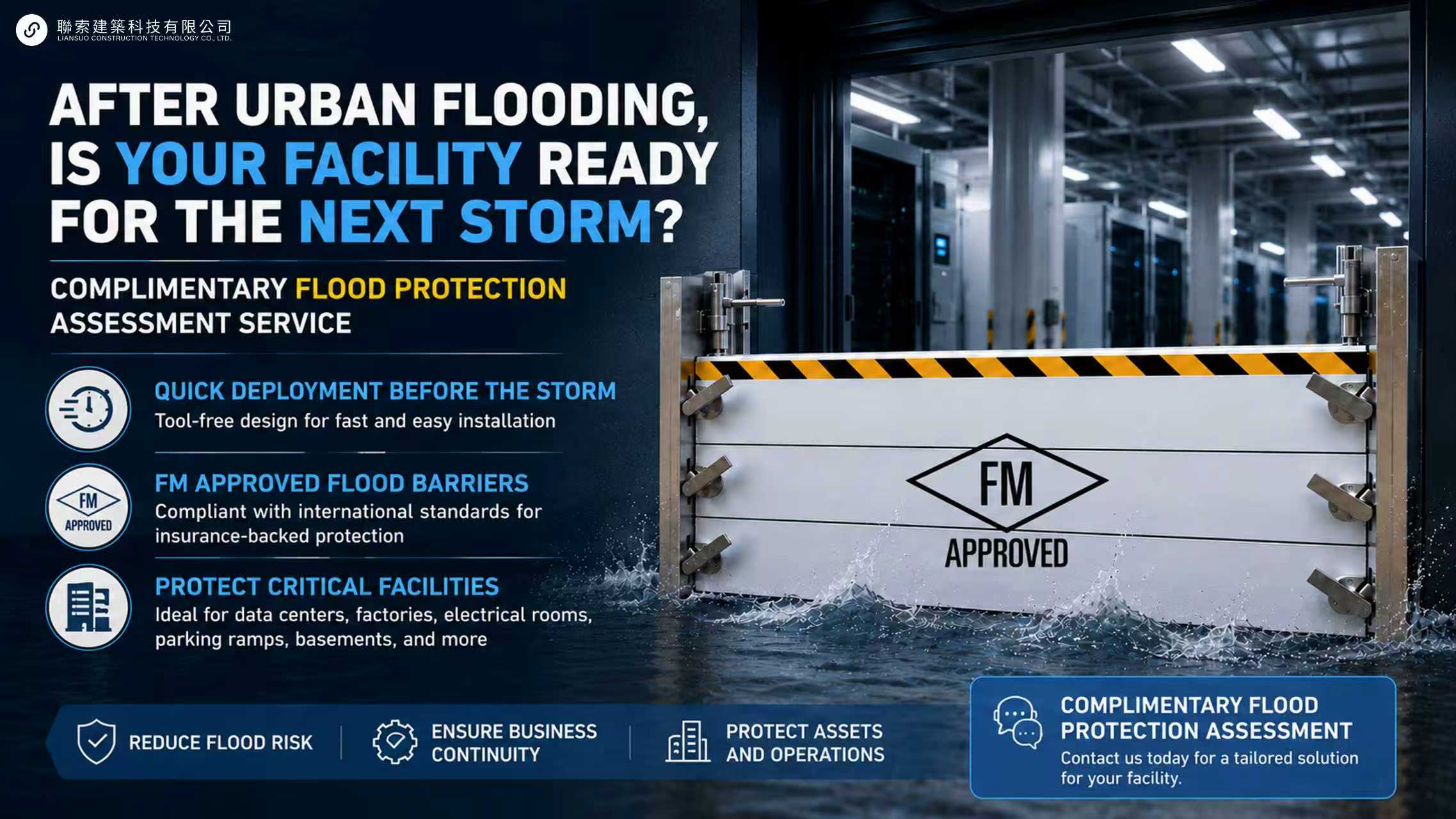
For businesses, the most important post-disaster task is not only to remove floodwater, but also to immediately review the risks exposed by this flooding event. These findings can serve as an important reference for flood prevention planning before the next heavy rainfall event.
Businesses are advised to first confirm the following three key points:
- The highest floodwater level during this event
- The locations where floodwater entered the building
- Whether flood protection measures can be deployed quickly before heavy rainfall occurs
To help affected businesses reduce the risk of future flooding, Liansuo Construction Technology offers a free flood risk assessment service. Based on on-site watermark height, floodwater entry points, and building opening conditions, we assist property owners in preliminarily evaluating the appropriate flood protection height and improvement direction.
Recommended Flood Protection Solutions Based on Floodwater Height
Every flooding event indicates that a building has already been exposed to a certain level of flood risk. Therefore, businesses are advised to use the actual floodwater height from this event as an important reference for planning future flood protection equipment.
| Actual Floodwater Height | Recommended Flood Protection Height | Suitable Applications |
|---|---|---|
| Approx. 100–250 mm | 300 mm | Shop entrances, commercial building lobbies, general entrances |
| Approx. 300–500 mm | 600 mm | Basement driveways, logistics entrances, factory entrances |
| Approx. 500–750 mm | 900 mm | Equipment rooms, UPS rooms, electrical rooms, equipment areas |
| Approx. 750–1000 mm | 1200 mm | High-risk underground areas, data centers, critical equipment areas |
If the actual watermark height has exceeded 1200 mm, it is recommended to also evaluate perimeter flood walls, drainage systems, pumping equipment, and building structural improvement measures. In such cases, relying solely on a single flood barrier or flood gate is not recommended.
Recommended Directions for Different Affected Areas
Different building openings have different flood risks and flood protection requirements. Suitable flood protection solutions can be planned according to the affected location.
| Affected Area | Common Issues | Recommended Solution |
|---|---|---|
| Shop / commercial building entrance | Water backflow at the entrance, surface water accumulation | 300–600 mm quick-install flood barrier |
| Basement parking entrance | Large amount of water entering from the driveway slope | 600–1200 mm flood barrier + pumping equipment |
| Factory entrance | Large opening size, relatively low floor level | 600–1200 mm flood barrier |
| Logistics loading area | Damage to goods and storage equipment | 600–900 mm removable flood barrier |
| Equipment room / UPS room / electrical room | Damage to electrical equipment and high risk of downtime | 900–1200 mm flood barrier |
| Data center | High risk of business interruption | External flood protection + secondary protection for critical equipment rooms |
As opening sizes, usage frequency, and protection requirements vary across different sites, it is recommended that professional personnel conduct an on-site assessment to develop the most suitable flood protection plan.
Information Required for the Free Assessment
To help businesses quickly determine suitable flood protection solutions, affected users are advised to provide the following information for preliminary assessment:
- The highest watermark height from this flooding event.
- Photos of the locations where floodwater entered the building.
- Width and height of the building openings.
- Photos showing the current condition of the floor and wall surfaces.
- Whether the area is a basement, underground driveway, equipment room, or critical equipment area.
- Whether there is a need to adopt FM Approved flood barriers.
- How many personnel can be arranged on site to complete flood protection deployment after a heavy rain warning is issued.
Complete on-site information helps shorten the assessment process and improves the accuracy of subsequent flood protection planning.
How Liansuo Can Assist
Based on site conditions and building requirements, Liansuo Construction Technology can provide the following preliminary assessment recommendations:
- Recommended flood protection height.
- Flood barrier layout planning.
- FM Approved flood barrier selection recommendations.
- Flood protection planning for basement driveways, factories, logistics entrances, and equipment rooms.
- Flood protection deployment procedures and equipment storage management recommendations.
- Pre-rainy season flood protection inspections and flood drill recommendations.
Through comprehensive early-stage planning, businesses can reduce equipment losses and operational interruption risks caused by heavy rainfall, while strengthening overall operational resilience.
Conclusion
This recent urban flooding event once again reminds businesses that flood prevention should not focus only on post-disaster pumping and cleanup. More importantly, businesses need to establish the ability to rapidly deploy flood protection measures before heavy rainfall arrives.
Floods cannot be scheduled, but flood protection height can be designed in advance;
Heavy rainfall cannot be avoided, but deployment time can be planned ahead.
For businesses that have experienced flooding, now is the best time to review the watermark height, floodwater entry points, and building opening conditions from this event, and to use these findings to plan a more complete flood protection strategy. This can help reduce the operational impact of the next heavy rainfall event.
Liansuo Construction Technology offers a “Free Flood Risk Assessment Service” to help businesses identify potential risks from this flooding experience, establish an actionable flood protection deployment plan in advance, and enhance the protection capability and business continuity of critical facilities.