The fire risks in data centers do not originate solely from servers, UPS systems, battery installations, or electrical distribution equipment.
According to industry experts, one of the most frequently overlooked risks involves the numerous penetrations created by cables, cable trays, bus ducts, ducts, and piping passing through fire-rated walls and floor assemblies.
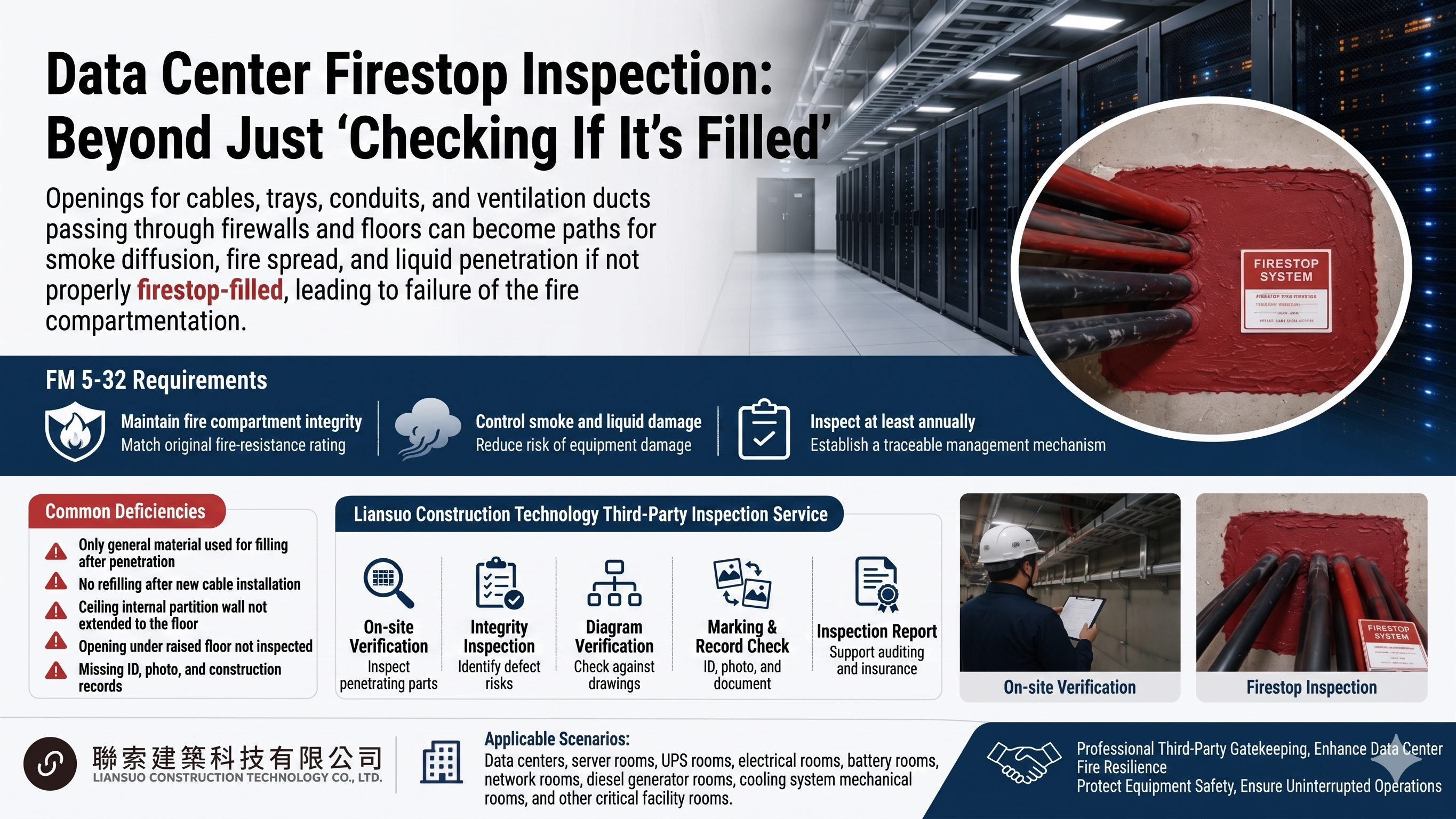
If these penetrations are not properly protected with qualified firestopping systems, they can become critical vulnerabilities within the facility.
Liansuo Construction Technology Co., Ltd. points out that improperly protected penetrations may become:
- Pathways for smoke migration
- Routes for fire spread
- Pathways for liquid intrusion and leakage
- Points of failure within fire compartmentation systems
Why Does FM 5-32 Emphasize Firestopping Inspections?
FM Global Data Sheet 5-32, Data Centers and Related Facilities, identifies not only fire itself but also smoke contamination, liquid damage, and natural hazard exposures as major threats to sensitive electronic equipment.
As a result, firestopping in data centers is not simply about filling openings. It must maintain several critical functions simultaneously:
- Fire compartment integrity – Preserving the original fire-resistance rating of fire-rated walls and floor assemblies.
- Smoke control – Reducing the risk of smoke migration into server rooms, UPS rooms, and electrical rooms.
- Liquid damage control – Limiting the spread of condensate, fire suppression water, and other liquids through penetrations.
- Operational management – Preventing firestop failures following equipment upgrades or cable additions.
- Documentation and traceability – Establishing a verifiable, recordable, and auditable management process.
FM 5-32 Requirements for Penetration Firestopping
Section 2.2.4 of FM 5-32 requires that all openings created by ducts, pipes, wires, and cables penetrating fire-rated walls and floors be protected using FM Approved or otherwise recognized Penetration Seal Systems.
The fire-resistance rating of the firestop system must be equal to or greater than that of the original fire-rated assembly.
For penetrations serving equipment rooms, FM 5-32 also requires low-leakage characteristics in addition to fire resistance.
Leakage rates should be minimized and should not exceed:
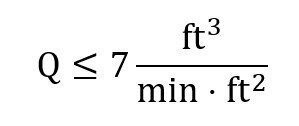
(approximately 2.1 m³/min/m²)
Furthermore, during new construction or renovation projects, FM recommends the use of approved temporary firestopping measures whenever work is suspended overnight, during weekends, or during other shutdown periods in order to reduce risk exposure.
In summary, FM 5-32 focuses on three key requirements:
- Firestop Systems Must Be Supported by Recognized Certifications
Openings should not be sealed using generic firestop putty, sealants, mineral wool, or other materials without a tested and approved firestop system design.
- Firestop Performance Must Match the Original Assembly Rating
The fire resistance of fire-rated walls and floors should not be compromised by penetrations.
- Smoke Control Capability Must Be Verified
Data center equipment is highly sensitive to smoke contamination, making low-leakage firestop systems an important requirement.
FM 5-32 Requires Annual Integrity Inspections
Section 2.7.1.2 of FM 5-32 requires data centers to establish a penetration management program to control smoke and liquid damage risks while maintaining the original fire-resistance performance of the building.
The management program should include:
- Maintaining records of existing and newly created penetrations.
- Requiring approval and permit procedures for new penetrations.
- Verifying that firestopping has been completed after construction activities.
- Retaining all related permits and installation records.
- Periodically auditing compliance with management procedures.
- Conducting firestop integrity verification at least once per year.
- Repairing and upgrading newly identified deficiencies or damaged areas.
FM 5-32 clearly states:
“Penetration firestop integrity should be verified at least annually.”
This means that firestopping in data centers is not a one-time construction activity—it is an ongoing facility management responsibility.
Which Areas Require the Most Attention?
Server Rooms
- Raised-floor voids
- Ceiling plenums
- Cable tray wall penetrations
UPS Rooms
- Raised-floor voids
- Ceiling plenums
- Cable tray wall penetrations
Electrical Rooms
- Bus ducts
- Cable trenches
- Conduit penetrations
Battery Rooms
- Bus ducts
- Cable trenches
- Conduit penetrations
Network and Telecommunications Rooms
- Low-voltage cable trays
- Fiber optic cable penetrations
Diesel Generator Rooms
- Power cables
- Fuel piping
- Exhaust duct penetrations
Chiller and Mechanical Equipment Rooms
- Water piping
- HVAC ducts
- Control cable penetrations
Renovation and Construction Areas
- Newly installed cables
- Temporary openings
- Unrestored penetrations
Common Deficiencies and Associated Risks
Cable Trays Sealed with Generic Materials
Fire resistance ratings and system compatibility cannot be verified.
Additional Cables Installed Without Reinstating Firestopping
Original fire compartmentation may be compromised.
Partition Walls Not Extended to Structural Slabs
Smoke may bypass fire barriers through concealed ceiling spaces.
Openings Beneath Raised Floors Not Included in Inspections
Hidden voids can become pathways for fire and smoke spread.
Lack of Identification Labels, Photographs, and Records
Future inspections and maintenance become difficult.
Temporary Construction Openings Left Unprotected
Risk exposure increases during shutdown periods.
Firestopping Inspection Services from Liansuo Construction Technology Co., Ltd.
Liansuo Construction Technology Co., Ltd. provides independent third-party firestopping inspection services to help owners, general contractors, MEP contractors, fire protection contractors, and insurance stakeholders evaluate the condition of firestop installations within data center facilities.
Service Scope
- Penetration Inspection
Inspection of cable trays, cables, pipes, ducts, bus ducts, and other penetration locations.
- Firestop Integrity Assessment
Verification of damage, missing materials, loosened installations, and unsealed secondary penetrations.
- Drawing-to-Site Verification
Review of fire compartments, walls, floors, and penetration locations against project documentation.
- Identification and Documentation Review
Verification of firestop numbering systems, photographs, and installation records.
- Annual Integrity Inspections
Supporting compliance with FM 5-32 annual verification requirements.
- Third-Party Inspection Reports
Providing inspection findings and documentation to support internal audits and insurance reviews.
The Value of Firestopping Inspections
- Ensuring Effective Fire Compartmentation
The performance of fire-rated walls and floors ultimately depends on the quality of every penetration firestop installation. - Reducing Smoke Damage to Electronic Equipment
Data center equipment is highly sensitive to smoke contamination, and firestop deficiencies can significantly increase non-thermal damage. - Supporting FM Risk Management Requirements
FM 5-32 specifically requires penetration management procedures and annual integrity verification programs. - Establishing a Traceable Management System
Identification labels, photographs, inspection records, and reports help transform firestop management from experience-based practices into a systematic and auditable process.
Conclusion
Firestopping inspections in data centers are far more than a commissioning or acceptance requirement.
They directly affect the effectiveness of fire compartmentation, the control of smoke migration, and the protection of critical equipment during an incident.
Based on the risk management principles outlined in FM 5-32, Liansuo Construction Technology Co., Ltd. provides independent third-party firestopping inspection services to help clients establish a firestop management system that is verifiable, traceable, and maintainable over the long term.
By strengthening firestop management, data center operators can improve overall operational resilience and enhance risk management performance.
Typical Applications:
Data centers, server rooms, UPS rooms, electrical rooms, battery rooms, network rooms, diesel generator rooms, chiller plants, HVAC equipment rooms, and other critical equipment spaces.