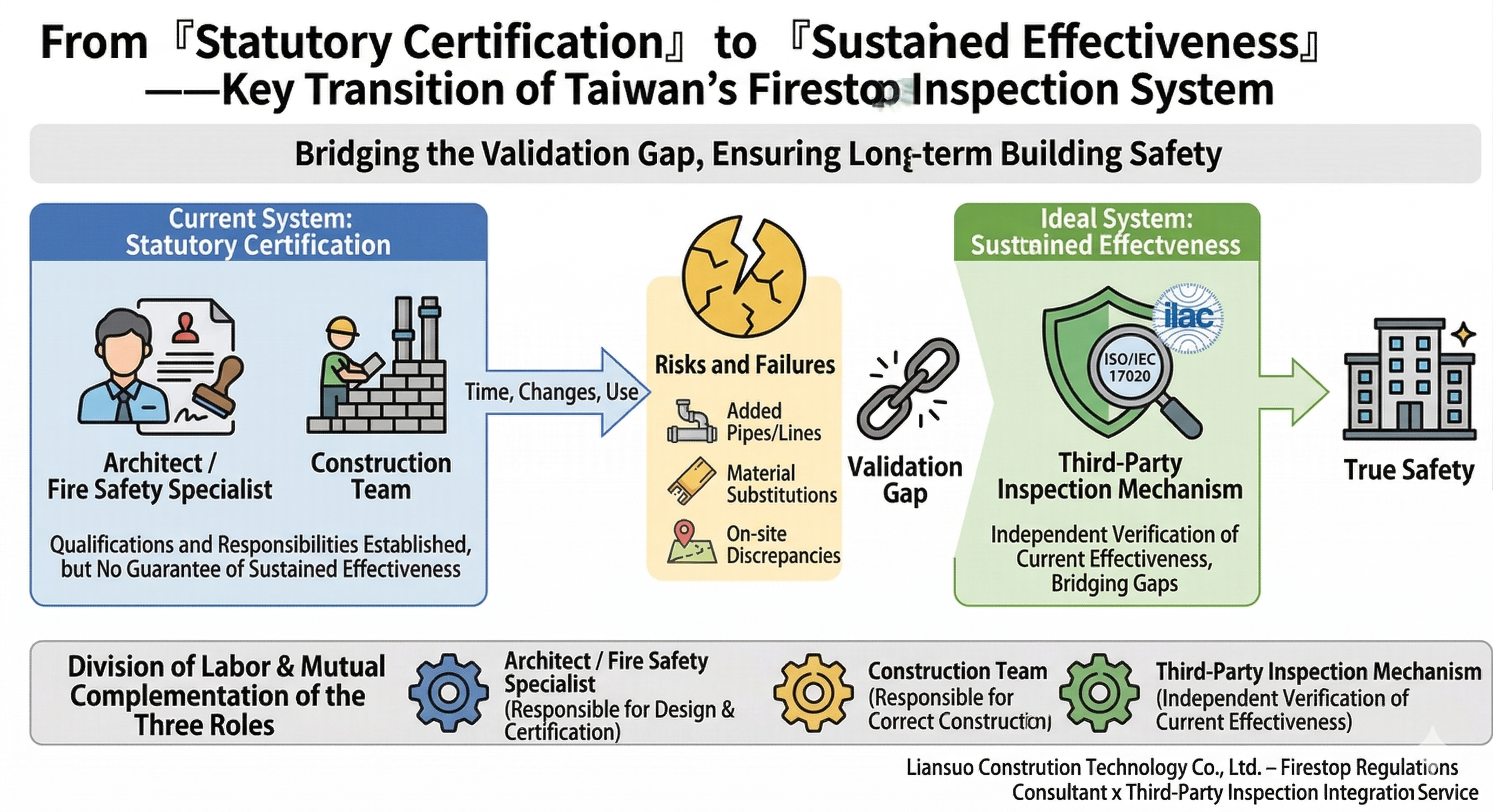
Under Taiwan’s current regulatory framework, the management structure for firestopping may appear comprehensive, but it still contains a critical link that is often overlooked.
In Taiwan, firestopping is not without a legal basis. Under the current fire safety and building-related regulatory system, works involving fire protection equipment are legally required to be signed off by qualified professionals, including architects, fire protection engineers, or fire protection technicians, depending on the nature of the work. These professionals must certify the design, supervision, testing, or inspection results within the scope of their professional practice and assume responsibility for their professional judgment.
From a regulatory standpoint, this process is valid in terms of both qualification and accountability. However, in practice, one frequently overlooked issue remains:
“Certification does not mean the system has been independently verified, nor does it mean it remains effective.”
The Nature of Firestopping:
A System That Cannot Prove Its Own Effectiveness
According to Liansuo, firestopping is a typical passive fire protection system with the following characteristics:
- It does not actively operate under normal conditions.
- Its performance cannot be measured during day-to-day operation.
- It is only truly tested under fire conditions.
Therefore, whether the system has been designed, installed, or certified by qualified professionals, this can only demonstrate one thing: under the conditions and assumptions at that time, the system was judged to be acceptable.
It does not guarantee that the system will remain valid after time has passed, changes have been made, and the building has been put into use.
In Practice, the Risks Often Emerge After Certification
In actual projects, firestop failure is usually not caused by the original design itself, but by subsequent changes, such as:
- New piping or equipment being added, damaging the original firestop.
- Material substitution or mixed use, resulting in non-compliance with the original tested conditions.
- Discrepancies between site conditions and drawings that were never traced back and corrected.
- Documentation remaining unchanged while the actual installed firestop condition has been altered.
Liansuo believes that these situations do not necessarily mean the original certification was wrong, but they may cause the system to no longer provide the fire performance originally intended from a technical standpoint.
The Role of Firestop Inspection:
Filling the “Verification Gap” in the System
Liansuo points out that the purpose of firestop inspection is not to replace the professional responsibilities of architects or fire protection engineers. Rather, it is to fill a necessary but often overlooked gap in the system:
“On top of certification and completed installation, independently confirm whether the system remains effective.”
The key question of inspection is not “Who signed off on it?” but rather:
- Does it still meet the technical requirements for fire compartmentation today?
- Does the current site condition still match the original design or approved basis?
- After modification, additional installation, maintenance, or use, does the system still perform as intended?
This is a question that can only be answered from an independent position.
Why Must Third-Party Inspection Be Built on Internationally Recognized Foundations?
If the inspection itself lacks institutional credibility, its conclusions are unlikely to be accepted by regulators, insurers, or project stakeholders.
Under ISO/IEC 17020:2012, Conformity Assessment — Requirements for the Operation of Various Types of Bodies Performing Inspection, qualified third-party inspection activities must demonstrate:
- Independence: No involvement in design, no execution of installation work, and no endorsement of any particular outcome.
- Consistency: Inspection methods and judgment logic are controlled and repeatable.
- Traceability: Conclusions can be traced back to standards, facts, and on-site evidence.
- Clear accountability: Verification is not replaced by experience or assumption.
When the inspection system is further incorporated into the ILAC international multilateral mutual recognition framework, its inspection results can offer the following value:
- They can be accepted by review, insurance, and audit systems across different countries and regions.
- They do not rely on a single legal jurisdiction or project-specific background.
- They provide cross-system consistency and comparability.
This elevates “inspection” from an internal management tool to a risk assessment basis that can be relied upon externally.
In Taiwan’s System, How Should These Three Roles Be Properly Separated?
Within the compliance and governance framework for firestopping, the following three roles should be clearly distinguished and function as complements to one another:
- Architects / Fire Protection Engineers
Responsible for design judgment, statutory certification, and professional accountability. - Contractors / Installation Parties
Responsible for carrying out the work correctly in accordance with the approved system. - Third-Party Firestop Inspection Mechanism
Responsible for independently verifying, on top of existing certification and completed installation, whether the system is still effective at present.
These three roles do not replace one another. Together, they form a complete chain of risk control.
Conclusion
When it comes to firestopping, legal certification is a necessary condition, but it is not a sufficient one. Real safety depends on whether the system can:
- Be reviewed again.
- Be independently verified.
- Remain valid over time and through change.
Liansuo emphasizes that for any building or critical equipment space requiring long-term operation, this is precisely the value of firestop inspection.
Liansuo Construction Technology
Firestop Compliance Consulting × Integrated Third-Party Inspection Services
Helping projects in Taiwan move from “legally completed” to “continuously effective”