For data centers, the greatest threats are not limited to power outages, fires, or cooling system failures.
Flooding, stormwater runoff, and backflow from underground drainage systems can also lead to the shutdown of servers, UPS systems, electrical rooms, battery rooms, diesel generator rooms, and cooling infrastructure, ultimately impacting business continuity.
Once water enters a data center, the consequences often extend far beyond localized repairs. Critical equipment downtime and operational disruption can result in significant financial and business losses.
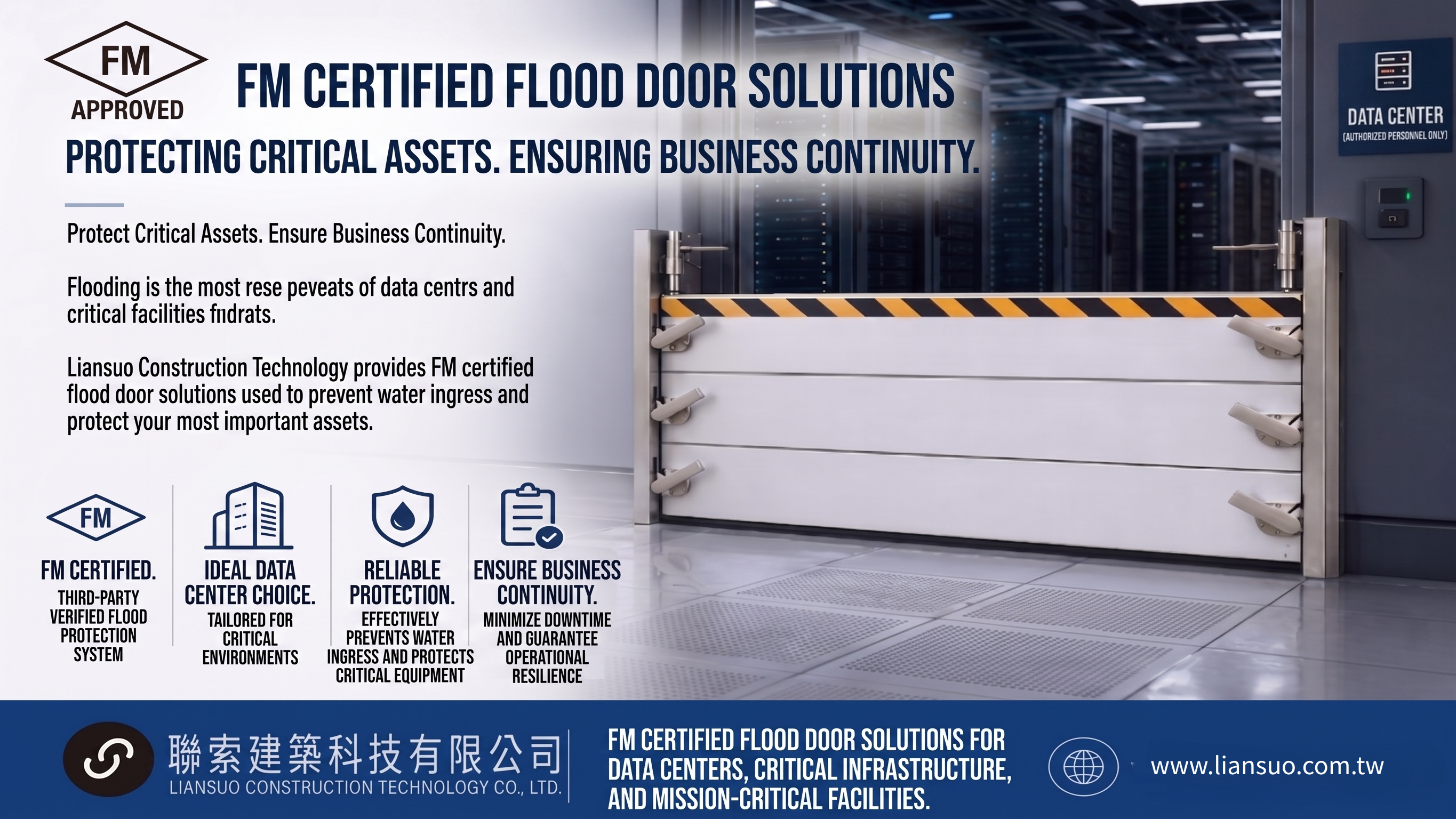
Key Flood Protection Considerations in FM 5-32
FM Global Data Sheet 5-32, Data Centers and Related Facilities, provides clear recommendations for flood risk management from the perspectives of property loss prevention and business continuity.
Key requirements include:
| Flood Protection Item | FM 5-32 Recommendation |
| Flood Elevation | Data center sites should be located above the 500-year flood elevation. |
| Freeboard | Provide an additional freeboard of 0.3–0.6 m above the design flood level. |
| Stormwater Runoff | Prevent surface runoff from affecting the data center and critical equipment. |
| Underground Areas | Provide dedicated drainage capacity for below-grade spaces. |
| Backflow Prevention | Install backflow prevention valves or equivalent devices. |
| Drainage Pumps | Pumps should start automatically and alarms should be connected to continuously monitored locations. |
| Emergency Power | Electrically driven drainage pumps should be connected to backup power systems. |
| Emergency Response Planning | If a 500-year flood event could impact the site, a flood emergency response plan should be established. |
The FM approach is straightforward:
Data center flood protection should not rely solely on drainage systems. The primary objective is to prevent water from reaching critical areas in the first place.
Why Do Data Centers Need Flood Doors?
Many data centers already incorporate drainage channels, sump pits, and pumping systems. However, these measures primarily address water after it has already entered the facility.
The real challenge is that water often enters through building openings first.
Common high-risk locations include:
| Location | Risk |
| Personnel Entrances | Stormwater can enter through doorways during heavy rainfall. |
| Loading and Logistics Entrances | Large openings increase flood exposure. |
| Equipment Access Doors | Wide openings are more difficult to seal effectively. |
| Underground Ramps | Water can rapidly flow into below-grade areas along ramp surfaces. |
| Electrical and Switchgear Rooms | Flooding may result in power outages. |
| UPS and Battery Rooms | Flooding can compromise power continuity. |
| Diesel Generator Rooms | Backup power availability may be affected. |
| Chiller Plants and Pump Rooms | Flooding can disrupt cooling system operation. |
For this reason, a comprehensive flood protection strategy for data centers should integrate six essential layers of protection:
Water Exclusion + Drainage + Backflow Prevention + Alarm Systems + Backup Power + Emergency Response Planning
The Value of FM Approved Flood Doors
Liansuo Construction Technology Co., Ltd. provides FM Approved Flood Door solutions specifically designed for critical entrances and equipment rooms within data center facilities.
- Third-Party Certified Performance
FM Approved Flood Doors are not ordinary flood barriers.
They are flood protection systems tested and certified in accordance with FM Approvals standards for flood mitigation products, making them suitable for high-value assets and critical infrastructure facilities.
- Designed for Critical Data Center Applications
Suitable for protecting:
- Personnel entrances
- Loading and logistics entrances
- Equipment access doors
- Underground ramps
- Electrical and switchgear rooms
- UPS rooms
- Battery rooms
- Diesel generator rooms
- Chiller and cooling equipment rooms
- Supports Insurance and International Compliance Requirements
For multinational corporations, facility owners, and insurers that adopt FM risk management standards, FM Approved products are more readily accepted as part of risk improvement programs and technical review processes.
- Shifting from Reactive Drainage to Proactive Flood Protection
Drainage systems manage water after it has entered a facility.
Flood doors create a physical barrier before water enters.
For data centers, preventing water intrusion is significantly more effective than attempting to remove water afterward.
Recommended Protection Locations
| Area | Recommended Protection Measure |
| Main Building Entrances | Install FM Approved Flood Doors |
| Underground Ramp Entrances | Flood doors at ramp entrances combined with drainage pumps at ramp bottoms |
| Logistics and Equipment Access Openings | Modular removable flood door systems |
| Electrical and Switchgear Rooms | Dedicated room-level flood protection |
| UPS and Battery Rooms | Dedicated room-level flood protection |
| Diesel Generator Rooms | Protect backup power system availability |
| Chiller Plants and Cooling Equipment Rooms | Reduce the risk of cooling system interruption |
Services Provided by Liansuo Construction Technology Co., Ltd.
Liansuo can assist data center operators with:
- Preliminary flood risk assessments
- Flood protection planning for building openings and critical equipment rooms
- Selection of FM Approved Flood Door solutions
- Evaluation of required protection heights and opening dimensions
- Installation interface and detailing recommendations
- Inspection, maintenance, and emergency drill procedures
- Technical coordination with owners, consultants, and insurance providers
Conclusion
Data center flood protection should not be evaluated solely based on drainage capacity.
Effective flood protection begins by preventing water from entering the facility.
A reliable FM Approved Flood Door protects far more than a building entrance—it helps safeguard critical equipment, power continuity, cooling infrastructure, and ultimately the business continuity of the entire data center operation.