As demand for AI data center construction continues to grow rapidly, the use of UPS lithium-ion battery systems, Battery Energy Storage Systems (BESS), and campus-scale energy storage systems is becoming increasingly widespread. Power stability and backup capacity have become critical issues for key infrastructure. However, lithium-ion batteries may still face safety risks during operation, including thermal runaway, flammable gas accumulation, and deflagration overpressure.
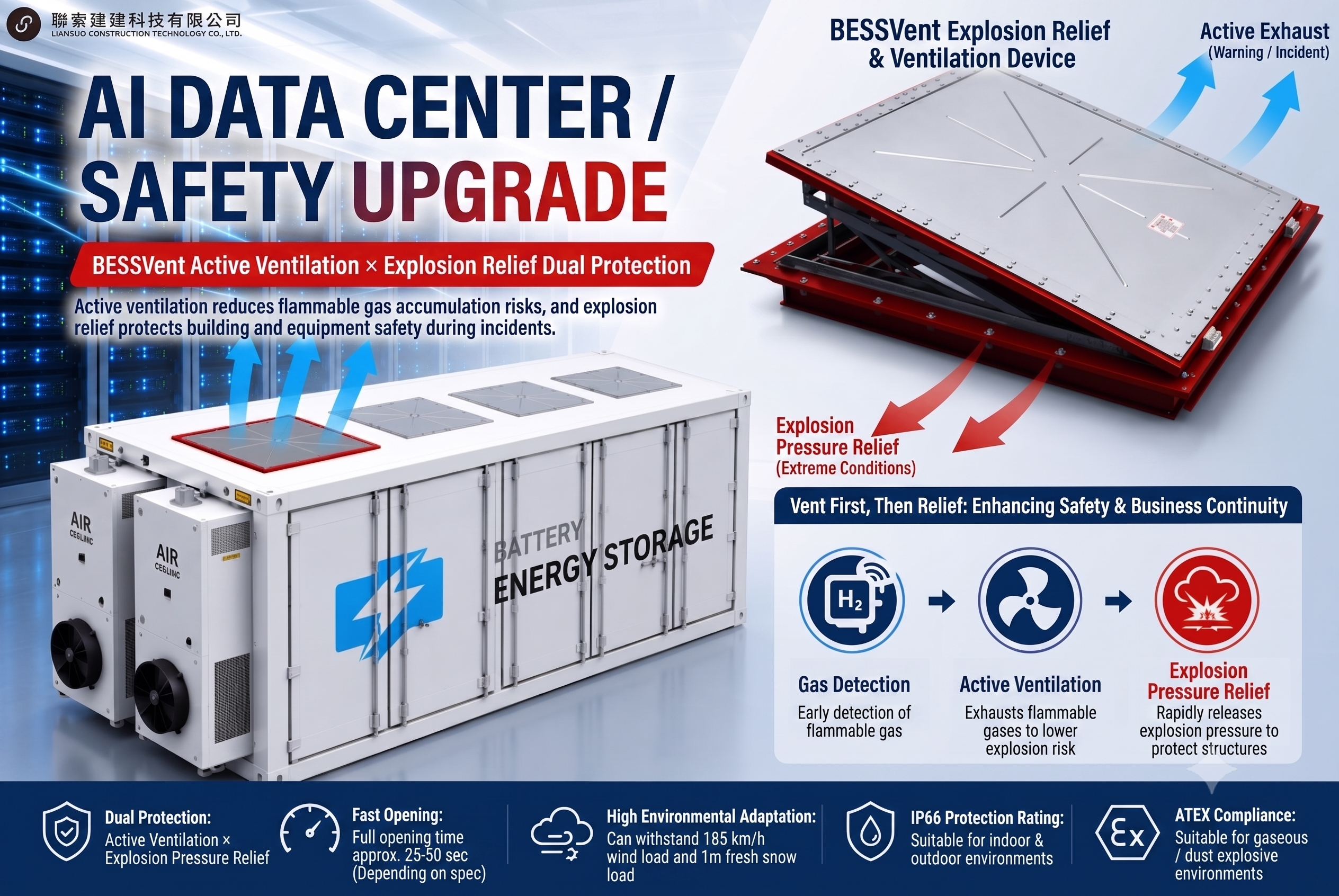
In response to these risks, BESSVent integrates active ventilation and explosion venting mechanisms to help AI data center battery rooms and energy storage enclosures establish a more comprehensive risk control strategy from the design stage.
Liansuo Construction Technology stated that when lithium-ion batteries experience thermal runaway, they may release flammable gases such as hydrogen (H₂), carbon monoxide (CO), and hydrocarbons. If ventilation in the battery room or energy storage enclosure is insufficient, these gases may quickly accumulate within the confined space. Once exposed to an ignition source, a deflagration event may occur, potentially damaging building structures, equipment, and facilities, and even affecting the continuous operation of the data center.
Why Do AI Data Center Battery Rooms Need Explosion Ventilation?
For this reason, battery safety design in data centers cannot rely solely on fire suppression systems. In the early stages of thermal runaway, flammable gases often appear before visible flames. If these gases are not detected and discharged in time, a flammable gas cloud may form, further increasing the risk of deflagration.
Therefore, the design of battery rooms and energy storage enclosures should generally take the following factors into consideration:
- Battery rooms should preferably be located near external walls
• Flammable gas detection systems should be installed
• Hydrogen detectors should be installed at higher locations within the space
• A tiered alarm mechanism should be established
• High-risk alarms should be linked with emergency ventilation systems
• Explosion relief facilities should avoid evacuation routes and emergency exits
Compared with emergency response after a fire has occurred, modern data centers place greater emphasis on risk control during the gas accumulation stage, in order to reduce the possibility of incident escalation.
Core Value of BESSVent
Liansuo Construction Technology pointed out that BESSVent is a battery safety device that integrates both active ventilation and explosion venting functions.
Under normal operation or early warning conditions, the system can open the cover panel through an electric linear actuator, helping discharge flammable gases accumulated inside the battery room or energy storage enclosure and reducing the conditions that may lead to deflagration.
In the event of an extreme deflagration incident, the device can serve as a predefined explosion relief opening, rapidly releasing deflagration pressure and reducing the risk of damage to the building envelope and equipment.
Its design concept can be summarized as follows:
“Active ventilation during normal conditions to reduce the risk of gas accumulation; rapid explosion venting during deflagration to protect building and equipment safety.”
Integration with Gas Detection and Fire Protection Systems
Liansuo Construction Technology stated that in AI data center applications, BESSVent can be integrated with flammable gas detectors and fire protection interlock systems.
When the detector issues an early warning signal, the device can automatically open according to preset control logic, helping discharge flammable gases generated by thermal runaway. If a deflagration event occurs, the device can release overpressure energy through a predefined venting path, reducing the risk of uncontrolled damage to doors, windows, walls, ceilings, and other building components.
This design concept of “ventilation first, explosion relief second” better meets the comprehensive requirements of AI data centers for safety, business continuity, and asset protection.
Application Scenarios
- UPS battery rooms in AI data centers
- BESS energy storage system enclosures
- Lithium-ion battery equipment rooms
- Solar-storage-charging integrated systems
- Commercial and industrial energy storage systems
BESSVent can help reduce the risk of flammable gas accumulation and cascading losses caused by thermal runaway.
Conclusion
Liansuo Construction Technology concluded that battery safety in AI data centers is not only a fire protection issue, but also closely related to business continuity, equipment protection, and operational risk management.
Through the dual mechanisms of active ventilation and explosion venting, BESSVent provides a more comprehensive risk control solution for data center battery rooms, energy storage enclosures, and energy storage systems, helping owners manage thermal runaway and deflagration risks in advance during the design stage.