In recent years, the frequency of extreme weather events has highlighted the growing threat of flooding and urban inundation to industrial parks and high-value facilities. For enterprises, adopting flood protection measures aligned with international standards is no longer just an extension of fire safety—it is a cornerstone of business continuity and financial resilience.
According to FM Global Data Sheet 1-40 (Flood Loss Prevention), flood protection can generally be categorized into two levels:
- Site Flood Protection: Perimeter defenses such as levees or floodwalls that create a “dry island.”
- Building Floodproofing: Measures applied at the building level, including flood doors, watertight barriers, and sump pump systems.
So why is building-level floodproofing often the superior choice in practice?
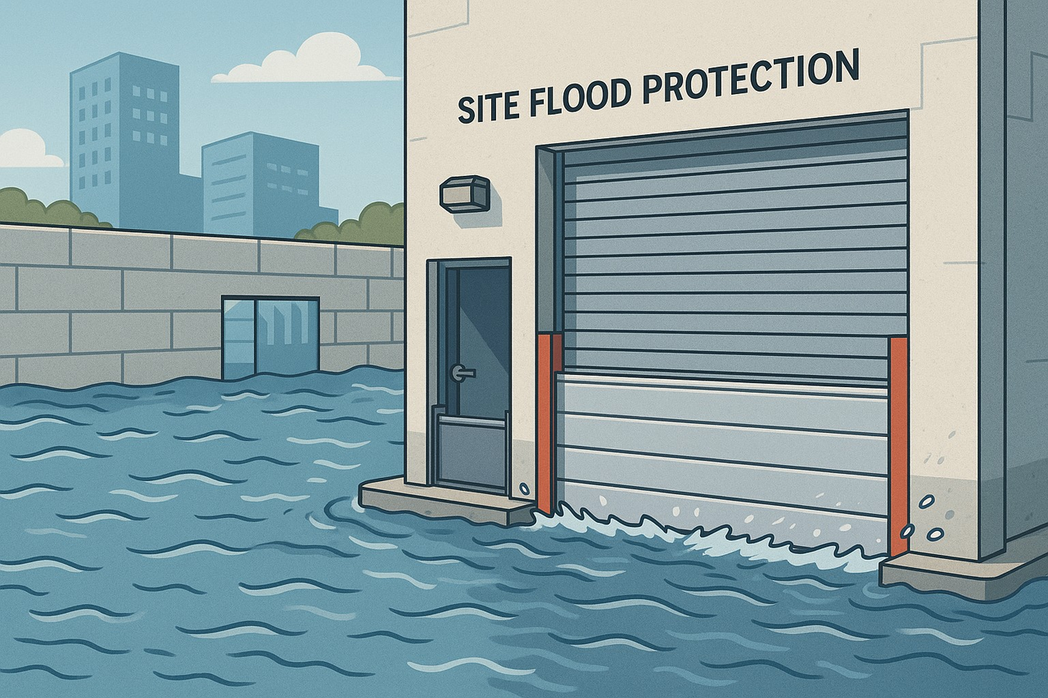
The Challenges of Site Flood Protection: High Cost, High Risk
Perimeter flood protection focuses on surrounding the entire site with large-scale defenses. While effective within the design limits, this approach poses structural and financial drawbacks:
- High Capital Investment – Involves large civil works, land acquisition, and ongoing maintenance.
- Fragile Failure Mode – Once overtopped or breached, the entire facility can be inundated, creating an “all-or-nothing” outcome.
- Operational Complexity – Multiple entrances and logistics routes require extensive manpower and time to deploy floodgates, which is impractical under short warning periods.
As a result, while site-level defenses offer broad coverage, they introduce a binary risk profile—either total success or catastrophic failure.
The Advantages of Building Floodproofing: Precision, Resilience, and Cost Efficiency
By contrast, building floodproofing aligns with FM 1-40’s principle of “resilient defense”, which accepts the possibility of partial failures while safeguarding overall operations. Key advantages include:
- Targeted Protection – Critical assets such as electrical rooms, control centers, and data facilities can be specifically secured.
- Flexible Deployment – Dry floodproofing solutions (e.g., flood doors and barriers) can be pre-positioned and installed quickly during warnings.
- Cost-Effective Implementation – Requires lower upfront capital and supports phased deployment; O&M costs remain manageable.
- Graceful Failure Mode – Even if one barrier fails, flooding is localized rather than site-wide, avoiding total shutdown.
This layered protection strategy is increasingly adopted by semiconductor fabs, pharmaceutical plants, and high-tech industries worldwide.
The Role of FM Approved Flood Doors
Among practical floodproofing solutions, FM Approved Quick-Fit Buckled Flood Doors stand out as one of the most effective options:
- Bolt-Free Buckle System – Enables two people to complete installation in under three minutes, reducing deployment errors.
- Wide-Span Capability – Covers openings up to 4 meters without center posts, making it suitable for logistics corridors.
- Strict Leakage Control – Certified performance of ≤ 1 L/hr·m² under design head, meeting FM standards for dry floodproofing.
- Reusable & Durable – Designed for repeated drills and emergency use, minimizing lifecycle costs.
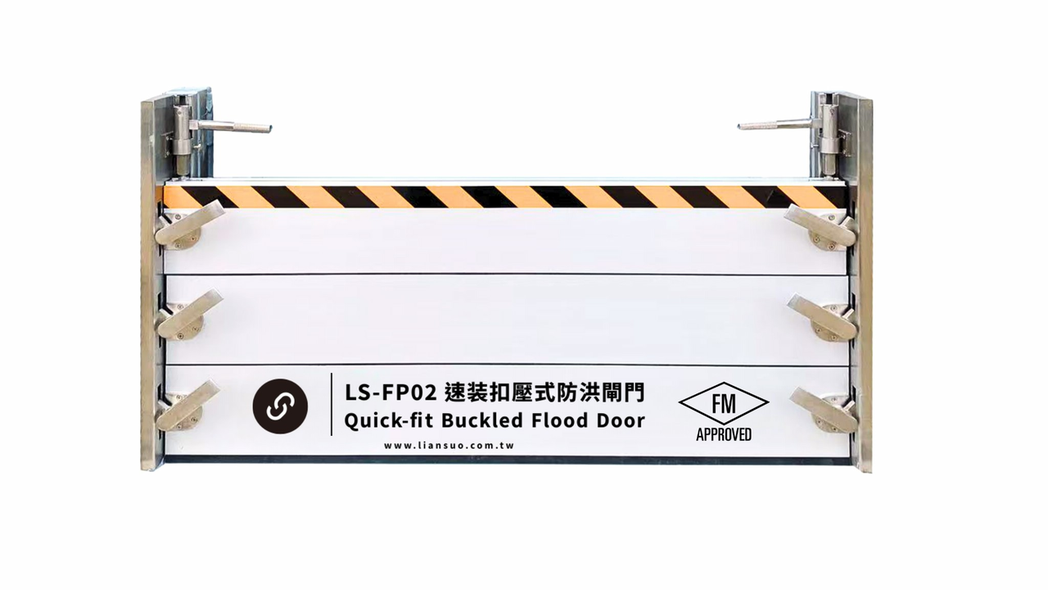
Such solutions are already applied in energy, automotive, semiconductor, and pharmaceutical facilities, proving to be a balanced choice of international compliance, cost efficiency, and operational resilience.
Conclusion: A Strategic Choice for Economic Resilience
FM 1-40 offers a clear design principle:
- Site flood protection may be suitable for compact campuses with few access points.
- Building floodproofing is far better suited for modern, complex facilities where logistics and critical infrastructure are dispersed.
For most industrial operators, adopting building-level floodproofing with FM Approved flood doors is not only a matter of safety—it is a strategic decision to ensure resilient operations and enhance insurability in the era of climate uncertainty.