To reinforce fire safety quality in high-rise buildings, Liansuo Construction Technology was invited by the Taipei Association of Fire Protection Engineers to deliver a professional presentation on international inspection standards for firestop systems and fire-resistant ducts at the Datong Sports Center International Conference Hall on November 27.
The session covered multiple international and domestic frameworks, including ISO, UL, FM, ASTM, and CNS standards, to help align Taiwan’s passive fire protection inspection practices with global compliance requirements.
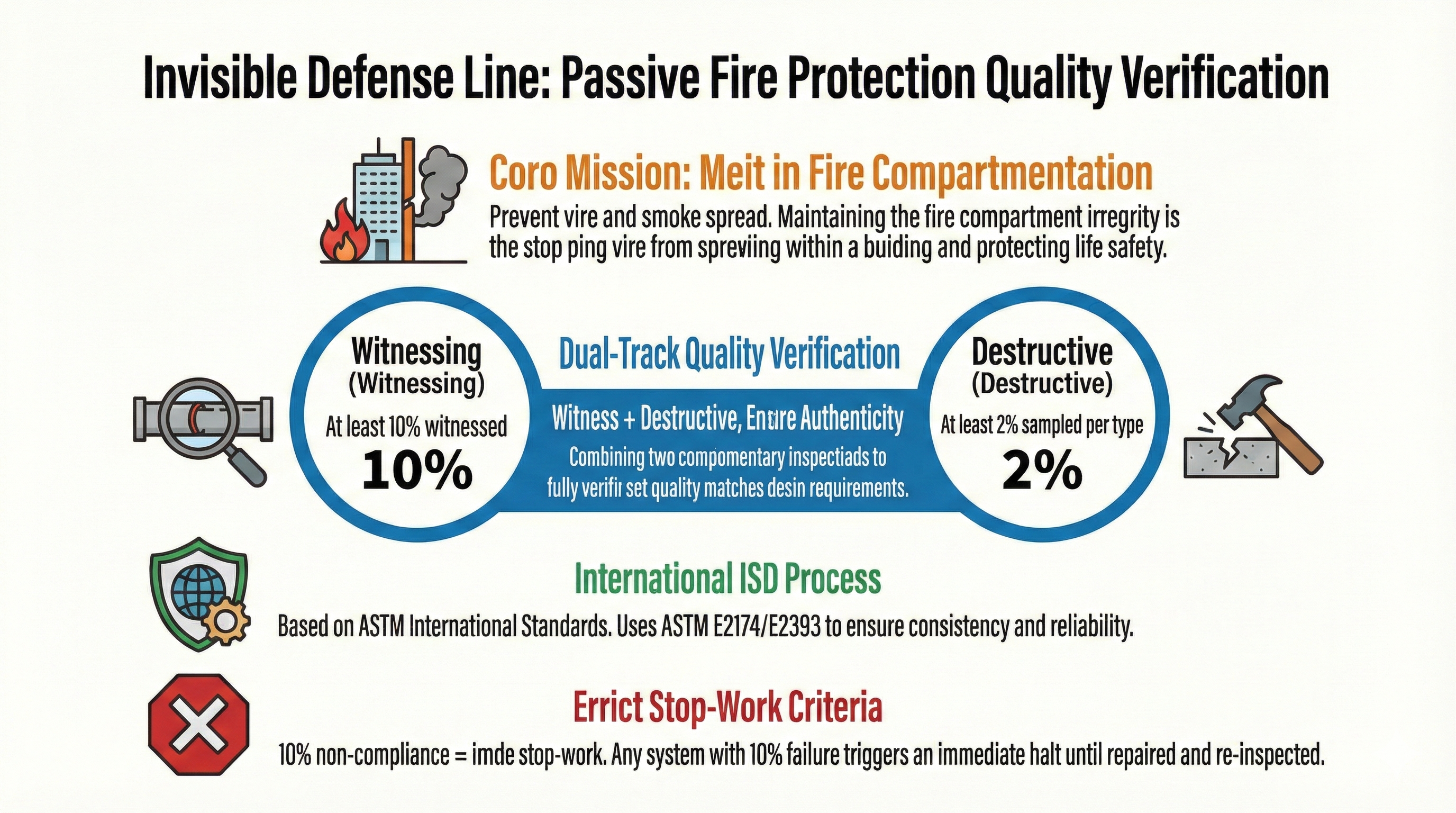
Passive Fire Protection Systems: Maintaining Compartment Integrity
Liansuo Construction Technology emphasized that the core objective of passive fire protection systems—such as firestop and building joint protection—is to maintain the integrity of fire and smoke compartments, thereby preventing fire and smoke from spreading throughout the building.
According to Chapter 17 of the International Building Code (IBC), high-rise structures and buildings classified under Risk Categories III and IV are required to undergo Special Inspections for firestopping systems. This process ensures that field conditions align with design performance, forming a traceable quality assurance mechanism.
International Qualifications and Standardized Inspection Processes
Liansuo Construction Technology holds FM and UL Qualified Firestop Contractor Designated Responsible Individual (DRI) credentials and is accredited under IAS/ILAC (AA-864) as a Type A third-party inspection body in accordance with ISO/IEC 17020:2012.
On-site inspection procedures are executed in line with international standards, including:
Firestop penetrations inspection — ASTM E2174
Building joint and curtain wall inspection — ASTM E2393
Fire-resistant duct inspection — ASTM E3385 (including ASTM E2336 / UL 2221, ISO 6944, and ASTM E2816)
Inspection items cover installation methods, annular space measurements, movement capability, material thickness, mineral wool density, duct construction, reinforcement members, and fire-resistance duration.
Dual-Track Quality Assurance: Witness and Destructive Inspections
To ensure authenticity and consistency in workmanship, a dual verification approach is adopted:
▪ Witness Inspection
– Minimum 10% of firestop penetrations observed
– Minimum 5% of building joint applications observed
▪ Destructive Testing
– At least 2% of each system type tested
– Minimum one test per floor or every 930 m²
If any system records a nonconformance rate of 10% or higher, an inspection suspension mechanism is activated, requiring contractors to implement corrective actions and pass reinspection before continuing work.
Case Study: Fire Safety Verification in Healthcare Buildings
Recently, Liansuo Construction Technology assisted National Taiwan University Hospital’s Health Building with an IAS-certified third-party firestop inspection conducted under ISO/IEC 17020:2012 and CNS 15814-1. A total of 38 firestop assemblies were randomly inspected, all of which fully complied with standard requirements—strengthening the resilience of fire safety in healthcare facilities.
Professional third-party inspection bodies play a critical role in building fire safety assurance systems. Through standardized procedures and internationally recognized inspection methods, they help buildings achieve higher levels of safety, compliance, and reliability.