1. Introduction
Flooding has long been one of the most economically devastating natural disasters globally. With the increasing frequency of extreme weather events, rapid urban expansion, and intensive land development, flood risks continue to rise. For critical facilities such as data centers, manufacturing plants, warehouses, and hospitals, a trustworthy flood protection system is often the first line of defense in safeguarding assets and maintaining business continuity.
Among the numerous flood protection product standards, one certification system is regarded by the industry as authoritative and a “gold standard”—FM Approvals (FM Certification). This document systematically analyzes FM certification’s technical logic, testing rigor, industry value, and practical significance, helping users make scientific and robust flood protection decisions in high-risk environments.
2. Product Highlights
2.1 What is FM Certification?
FM Approvals is the independent testing and certification division of FM (Factory Mutual), an international property insurance institution. Its core mission is not formal document review, but rather to verify through rigorous scientific experimentation whether products genuinely possess the ability to reduce disaster losses.
In the flood protection sector, FM’s primary certification basis is:
ANSI/FM Approvals 2510 “Flood Barrier” Standard (Latest Version: ANSI/FM 2510-2020)
This standard has been formally adopted by the American National Standards Institute (ANSI) and is currently recognized as one of the world’s most stringent flood protection product testing systems. Its testing focus includes:
Comprehensive verification of components and complete systems
Simulation of realistic flood scenarios
Multi-dimensional performance testing (hydrostatic pressure, impact resistance, durability, structural stability)
Continuous quality inspections of manufacturing facilities
In simple terms, FM certification is not a one-time test, but rather a long-term systematic review mechanism.
3. Standards Compliance
ANSI/FM 2510 classifies flood protection products into different application categories, each with independent testing procedures:
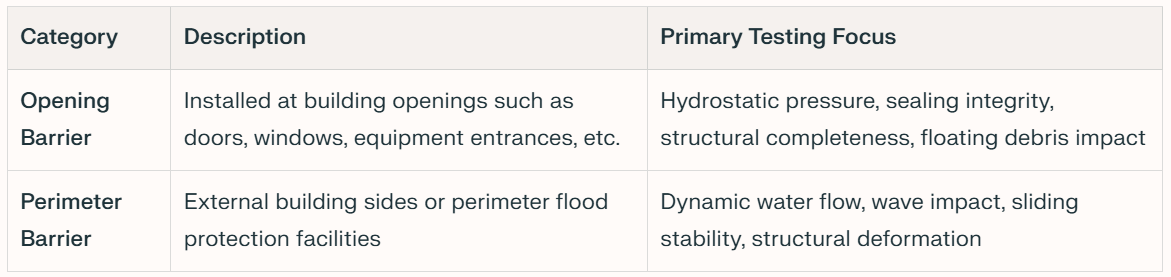
Opening barriers are the most commonly used by enterprises, and this document focuses on this category.
4. Application Scenarios
FM 2510 certified flood protection systems are widely applied in:
Data centers and server rooms
Semiconductor and precision manufacturing industries
Distribution centers, food factories, pharmaceutical plants
Commercial and residential building basements
Hospitals, laboratories, biotechnology facilities
Substations, generator rooms, electrical distribution rooms
These facilities share a common requirement: to block water from entering critical spaces during flooding events.
5. Value Proposition
5.1 Hydrostatic Pressure Testing: Proof of Ultimate Sealing Capability
FM 2510 subjects flood protection products to continuous submersion at maximum design water depth for up to 20 hours, requiring:
Leakage rate ≤ 1 liter/hour/per meter of seal length
This is one of the most stringent standards in the industry today.
Equivalent description:
After withstanding enormous water pressure for nearly 24 hours, the water seeping through per meter of seal length does not exceed the capacity of a paper cup.
Successfully passing this test demonstrates that the product possesses exceptional water-tightness and can protect equipment and materials from water infiltration during prolonged flood events.
5.2 Dynamic Impact Testing: Verification of Structural Anti-Destruction Capability
Floating debris carried by floodwaters possesses tremendous destructive power. Testing employs:
50-kilogram logs
Mechanical impact energy of 600 joules applied
Minimum of two impacts on the flood barrier
Testing objectives:
Whether the door panel structure remains intact
Whether fixation to walls or foundation structures loosens
Whether water-proof and protective functions persist after impact
Passing this test indicates that the product can resist unpredictable powerful impacts from floodwaters.
5.3 Continuous Monitoring of Manufacturing Systems
Another core value of FM certification is that after certification is achieved, products must continue to undergo:
Regular factory audits
Material and component traceability verification
Finished product sampling tests
Documentation consistency validation
Only through these continuous monitoring measures can products maintain their “FM Approved” status.
6. Conclusion: Why FM Certification is Recognized as the Gold Standard for Flood Protection?
Choosing FM 2510 certified flood protection products means gaining the following value:
Extremely high-level water-sealing performance
Maintains extremely low leakage under extreme water pressure, effectively protecting critical assets.
Robust impact resistance and structural stability
Can withstand high-speed impact from floating debris, ensuring protective function does not fail due to damage.
Manufacturing quality can be completely traced and verified
FM’s continuous quality audits ensure product consistency and reliability.
Core tool for risk management and FERP (Flood Emergency Response Planning)
Helps enterprises respond to extreme weather events and enhance disaster resilience.
High recognition from international insurance institutions
FM certified products are commonly used in high-risk areas and are the preferred choice for industrial facilities.
Conclusion
In an era of escalating flood threats, flood protection is no longer simply about installing a door, but rather establishing a safety system capable of withstanding extreme disaster scenarios. FM Certification (FM Approvals), through its scientific, rigorous, transparent, and verifiable testing system, has become the international gold standard for protecting critical assets and ensuring business continuity.
Liansuo Construction Technology will continue to adhere to the technical principles of FM 2510, providing highly reliable flood protection solutions for data centers, industrial plants, and infrastructure facilities, assisting customers in meeting new challenges posed by extreme climate change using international standards.