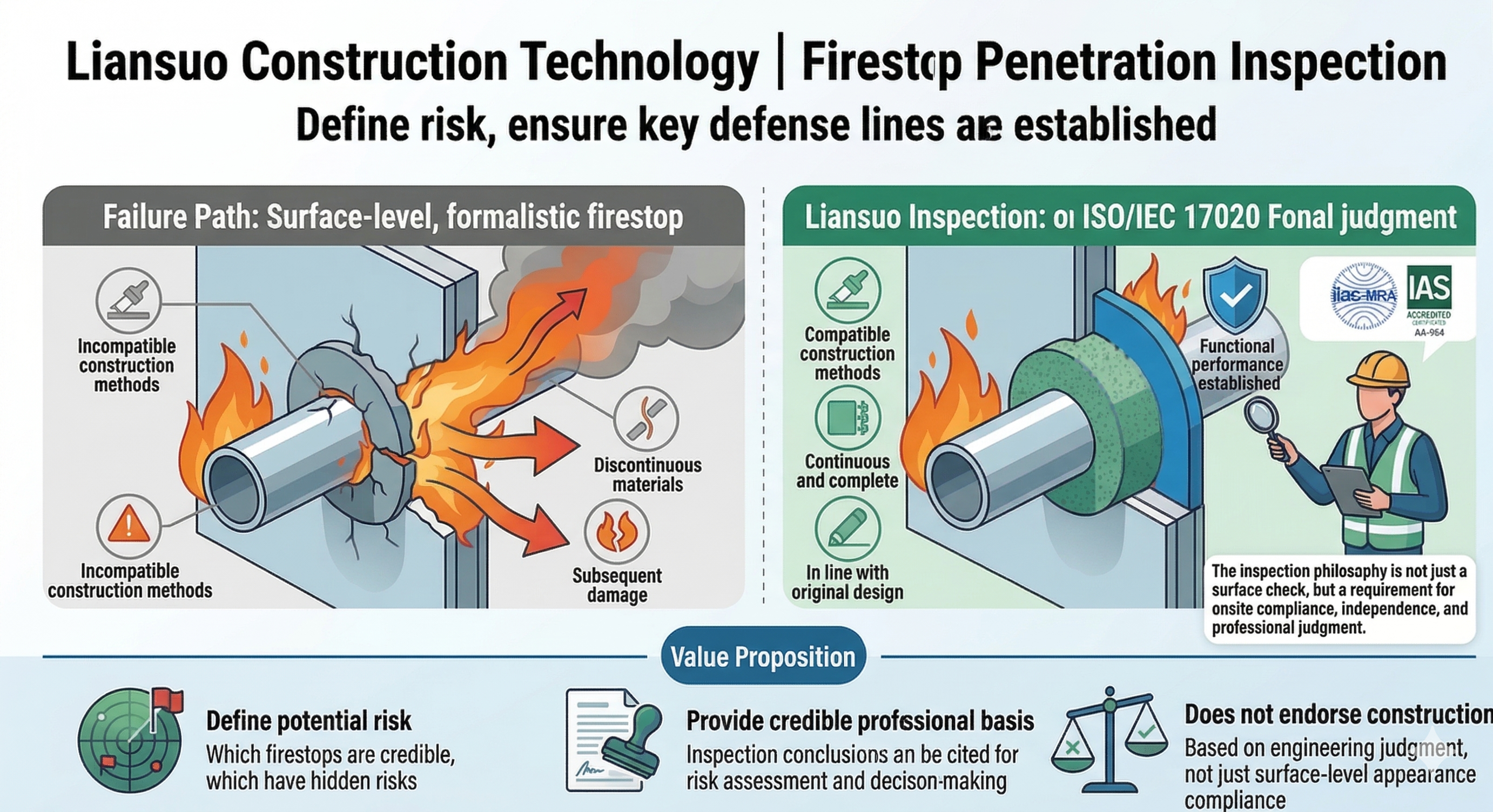
Within a building’s fire protection system, firestopping is often one of the least visible elements, yet it can decisively affect the outcome of a fire. What truly needs to be verified is never simply whether firestopping has been installed, but whether, in the event of a fire, it can actually prevent the spread of flames, hot smoke, and heat.
Liansuo provides third-party firestop inspection services. Our inspection methodology follows the principles of independence, professional judgment, and traceability emphasized under the ILAC international accreditation framework and ISO/IEC 17020 for inspection bodies. With engineering judgment at its core and risk identification as its purpose, we conduct independent, professionally defensible inspections of the actual effectiveness of firestopping systems.
Firestopping often attracts attention only after an incident has occurred
In most construction projects, firestopping typically has the following characteristics:
- It has already been installed.
- It has already passed visual acceptance.
- It is rarely mentioned again during normal operation.
However, in post-fire incident reviews, failed firestopping is often found to have become a primary path for the rapid spread of flames and smoke. The role of Liansuo’s inspection lies precisely in the critical gap between “installation completed” and “functional performance truly achieved.” Our inspection approach goes beyond surface-level checking and is more aligned with the expectations placed on third-party inspection bodies under ISO/IEC 17020 regarding on-site conformity, independence, and responsibility for professional judgment.
Core judgment: firestop inspection is never just about whether the opening has been filled
A truly effective firestop must satisfy multiple engineering conditions, including but not limited to:
- Whether the type of penetrated assembly matches the selected firestop system or method.
- Whether the firestop materials are continuous, complete, and have not been interrupted or substituted.
- Whether the firestopped area has been damaged, weakened, or deformed by subsequent construction activities.
- Whether the actual on-site condition still conforms to the original design assumptions and service conditions.
A fire will not consult construction photos or record files. It will simply spread along the weakest and most failure-prone path. Therefore, a truly valuable firestop inspection is not a formality based on photographs and file retention. It is a professionally reasoned assessment, made in line with the inspection judgment principles emphasized in ISO/IEC 17020, of the on-site configuration, the conditions required for functional performance, and the potential risks of failure.
Liansuo’s firestop inspection philosophy: defining risk, not endorsing construction outcomes
Do not substitute complete paperwork for on-site judgment
Liansuo’s inspection focus is not merely whether a system number or installation method exists on paper, but whether the actual site condition truly satisfies the prerequisite conditions under which that system is valid. This inspection logic is consistent with the core requirement in ISO/IEC 17020 for independent on-site judgment by inspection bodies.
Do not assume functional performance from acceptable appearance
A smooth surface does not mean the internal construction is continuous. Local compliance does not necessarily mean overall fire integrity has been achieved.
Inspection conclusions must be usable and citable
Inspection results should be understandable and usable by designers, owners, and reviewing authorities as a basis for subsequent risk assessment and decision-making, rather than serving merely as a formal record. This reflects the value that the ILAC-accredited inspection framework and ISO/IEC 17020 place on inspection reporting: not to endorse construction work, but to provide traceable and reliable professional judgment.
Typical applications
- Data centers, server rooms, and electrical rooms
- Buildings requiring high fire-resistance ratings and other critical-function spaces
- Fire compliance or risk assessment projects requiring independent third-party judgment
- Projects requiring inspection reports with independence, citability, and internationally recognized inspection logic
These environments do not need highly visible inspection activity. What they need is the certainty of not failing when a fire occurs.
Value proposition
The value of firestop inspection does not lie simply in whether something “passes” or “fails.” Its value lies in enabling decision-makers to clearly understand which firestops are reliable and which areas still present potential risk.
What Liansuo provides is not a reassuring conclusion for its own sake, but a foundation for fire risk judgment that follows the spirit of ILAC international accreditation and the inspection logic of ISO/IEC 17020—one that can be incorporated into real decision-making.