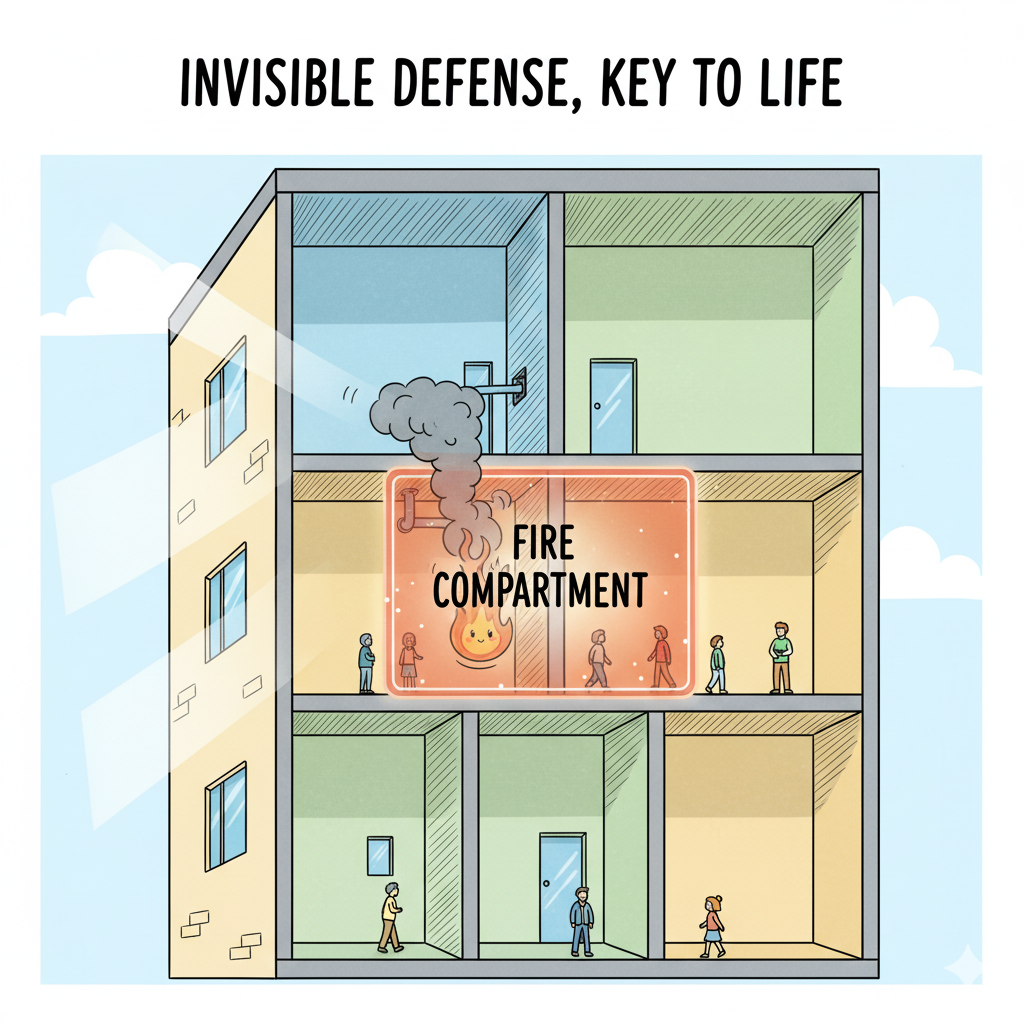
In almost every large building, there is a safety system that you might never notice. It is not an alarm or a sprinkler system, but it may be the most critical factor in protecting lives during a fire. This system is firestopping and fire compartmentation.
A Lesson From the Hsinchu Fire
On May 26, 2024, a fire broke out in a 28-story residential building in Hsinchu, Taiwan. The fire itself was not severe, yet it tragically claimed the lives of two firefighters. They did not succumb to flames, but to toxic smoke that spread throughout the building, turning stairwells and homes into deadly traps.
Investigations revealed that the issue lay with the failure of the firestopping system. The specialized sealant materials meant to close gaps between shafts and living units were either missing entirely or installed incorrectly. These seemingly minor gaps led to a total breakdown of the building’s safety barrier.
How Should Buildings Stop Fire Spread?
The key is fire compartmentation. Buildings are like ships, divided by “watertight bulkheads” that keep fire within a designated area, prevent the spread of smoke and flames, and buy precious time for evacuation.
Supporting all of this is passive fire protection: fire-rated walls, floors, doors, and ducts—hidden guardians embedded in the building’s structure. The real challenge arises when pipes, cables, and ducts penetrate these components; without proper firestopping and rigorous inspection of fire-rated ductwork, the protective “box” collapses.
Why Does Failure Keep Occurring?
Based on long-term inspections and project research, Liansuo Construction Technology has identified several root causes:
- Absence of a fully qualified single “Designer of Record”;
- Corner-cutting under cost pressure;
- Regulatory loopholes that fail to cover ductwork inspections;
- Contractors lacking awareness of correct firestopping and fire-rated ductwork methods.
The result: safety becomes a gamble.
Liansuo’s Solution: Process Verification + Comprehensive Inspection Services
Solving these issues requires more than hope—it demands verification. This is the importance of Process Verification.
As an IAS/ILAC accredited inspection agency, Liansuo Construction Technology not only provides firestop inspection services but is also the first in Taiwan to be certified for fire-rated ductwork inspection, filling a long-standing industry gap. Our inspections follow ISO/IEC 17020 international standards and cover two main areas:
Firestop Inspection:
- Document review: Pre-installation design and specification checks;
- On-site witness: Random inspection during installation (10% witness sampling);
- Completion verification: Destructive sampling (2% cut-open checks);
- Ensuring all penetration points are fully sealed to maintain compartment integrity.
Fire-Rated Ductwork Inspection:
- Compliance with ASTM E3385 and relevant international standards to verify system integrity;
- Inspection of sealing measures at duct penetrations through walls and floors;
- Evaluation of installation quality for both ductwork and fire-resistant coverings;
- Guaranteeing that, in a fire, ducts do not become “invisible highways” for smoke and flames.
True Safety Requires Independence
Liansuo emphasizes that genuine safety inspections must be performed by a fully independent Type A Inspection Agency.
- Contractors prioritize schedules and costs;
- Type A Inspectors have one sole duty: ensuring compliance and safety, free from conflicts of interest.
This is the value of Liansuo’s service: we do not participate in design, construction, or material supply—our single focus is independent inspection to safeguard safety.
Conclusion
Alarms and sprinkler systems are visible defenses, but what truly buys survival time is the invisible passive fire protection—firestopping and fire-rated ductwork.
Liansuo Construction Technology reminds you: The real question is not whether “design exists,” but whether this life-saving line has undergone independent verification. Because the answer is so often the dividing line between life and death.