Introduction|The Invisible Safety Net
High-rise buildings may look solid and secure, but the true guardians of life safety lie hidden within walls, floors, and ceilings—the passive fire protection systems.
These systems must effectively contain smoke and flames, preserve structural integrity, and provide precious evacuation time during a fire.
However, such protection doesn’t rely on belief—it is ensured by strict implementation of standardized inspections and internationally recognized verification systems.
Liansuo Construction Technology has long conducted inspection and conformity verification services based on three international ASTM on-site inspection standards (ASTM E2174, E2393, E3385), integrating the ISO/IEC 17020 and ILAC MRA mutual recognition framework.
Together, these three ASTM standards form the global core framework for fire protection inspection.
 Regulatory Enforcement and International Framework:
The “Special Inspection” System in IBC Chapter 17
According to Chapter 17 of the International Building Code (IBC), high-risk facilities such as hospitals, data centers, and super high-rise buildings must undergo Special Inspections.
This system requires the building owner to engage an independent and qualified third-party inspection agency to verify construction quality according to standardized procedures.
Within the field of passive fire protection, the IBC specifies the use of the following three ASTM standards:
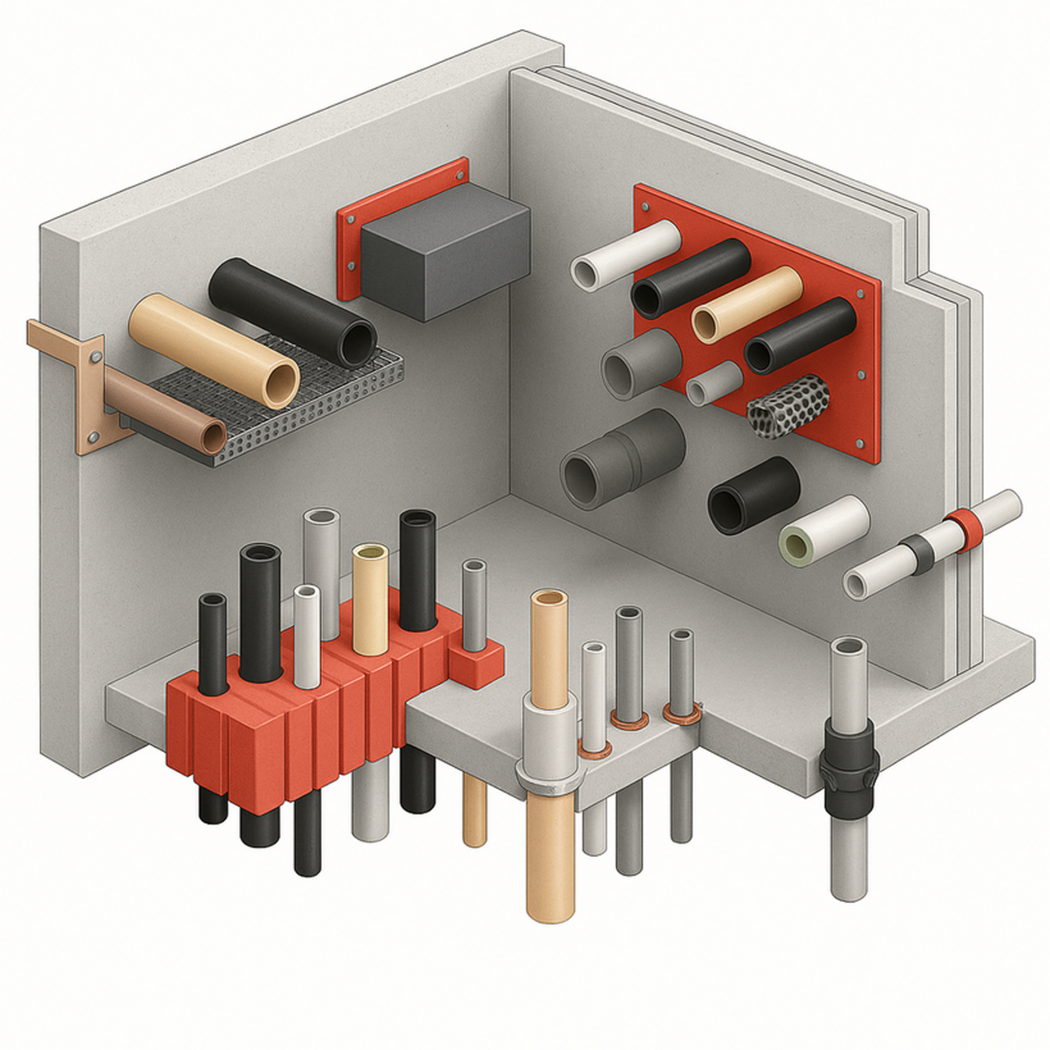
- ASTM E2174 — Through-Penetration Firestop Systems
- ASTM E2393 — Fire-Resistive Joint Systems & Perimeter Fire Barriers
- ASTM E3385 — Fire-Resistive Duct Systems
These are not performance tests but on-site inspection practices that confirm whether installations comply with design documents and certification listings (e.g., UL, FM Approvals).
They establish standardized sampling ratios, witnessing methods, and reporting formats that ensure traceability and international recognition.
ASTM E2174 — On-Site Inspection of Firestop Penetration Systems
Full Title: Standard Practice for On-Site Inspection of Installed Firestops
Latest Version: ASTM E2174-20a
This standard defines inspection procedures for firestop systems used in penetrations such as cables, pipes, and conduits, and requires inspection by qualified and independent personnel.
Two inspection methods are defined:
- Witnessed Installation: Random witnessing of a minimum sample proportion during installation (commonly around 10%).
- Post-Installation Destructive Verification: Minimum sampling ratio after completion (typically 2% per 10,000 ft²) with subsequent repair.
ASTM E2174 does not prescribe performance values or brand-specific materials. It focuses on verifying that installation and documentation are consistent.
Inspection reports must record sample locations, system IDs, repair details, and dates to ensure traceability.
ASTM E2393 — Inspection of Fire-Resistive Joint and Perimeter Systems
Full Title: Standard Practice for On-Site Inspection of Installed Fire Resistive Joint Systems and Perimeter Fire Barriers
Latest Version: ASTM E2393-20a
This standard covers inspections for linear joint systems at wall and floor intersections and fire barriers along curtain wall perimeters.
Sampling is based on linear length:
- Witnessed inspection ≥ 5% of total length during installation to verify joint filling and backing compression depth.
- Destructive verification after completion (e.g., one sample per 500 linear feet), followed by repair by the installer.
E2393 follows the procedural framework of E2174 but emphasizes measurements such as joint width, sealant thickness, and backing compression, while requiring photographic records to support reports.
It does not assess fire performance; those values are determined by ASTM E1966 or UL 2079 tests.
ASTM E3385 — On-Site Inspection of Fire-Resistive Duct Systems
Full Title: Standard Practice for On-Site Inspection of Fire Resistive Duct Systems
Latest Version: ASTM E3385-24
This standard provides inspection procedures for fire-resistive duct enclosures in HVAC, smoke exhaust, and pressurization systems.
It focuses on verifying that on-site installations match certified listings and properly document parameters such as material thickness, lap lengths, and hanger configurations.
Like E2174 and E2393, E3385 clearly specifies that it is an inspection practice, not a fire test standard—it sets verification and reporting protocols, not performance ratings.
Complementary Application of the Three Standards
- E2174: For through-penetration firestop systems (cables, pipes, conduits)
- E2393: For linear joints and curtain wall perimeter systems
- E3385: For fire-resistive ductwork and enclosures
Together, they form a comprehensive inspection framework for fire-rated sealing systems in buildings and are referenced in U.S. IBC special inspection clauses and insurance quality standards (e.g., FM Approvals, NFPA data sheets).
In practice, project specifications often require third-party agencies to perform sampling and reporting based on these three ASTM standards to ensure construction compliance with design documents and certification systems, creating verifiable evidence recognized by Authorities Having Jurisdiction (AHJ) and insurance engineers.
Global Recognition: From ASTM Practices to ISO/IEC 17020 and ILAC MRA
The ASTM E2174, E2393, and E3385 standards define how on-site inspections are conducted,
while ISO/IEC 17020 and ILAC MRA establish who is qualified to conduct them.
ISO/IEC 17020 stipulates the independence, impartiality, and technical competence of inspection bodies.
ILAC MRA ensures mutual recognition of inspection results among accreditation bodies in signatory countries.
Thus, an inspection report carried out under ASTM standards and issued by an ISO/IEC 17020-accredited body is globally recognized—offering true “one inspection, global acceptance.”
Building on this framework, Liansuo Construction Technology provides globally recognized inspection reports for firestop, fire-resistive duct, and curtain wall perimeter systems—supporting designers, certifiers, and insurers with traceable and internationally accepted compliance evidence.
Conclusion|The True Foundation of Safety
ASTM E2174, E2393, and E3385 do not test the fire—they test whether people followed the standard correctly.
They transform passive fire safety from a matter of trust into a system built on verifiable evidence and globally consistent procedures.
True safety often lies in the silent details.
Liansuo Construction Technology is committed to ensuring that every wall, duct, and joint can be trusted worldwide through the strength of international standards.